Showing posts with label green building. Show all posts
Showing posts with label green building. Show all posts
Tuesday, May 7, 2013
New Solar Skylights by VELUX
*30% solar tax credit may apply to skylight and installation cost.
For more information or contact information visit Forrest Glover Design

Wednesday, May 23, 2012
Metal Roofing
Though metal roofs have a great amount of embodied energy and cost more up front. There are many advantages to them.


 Home design for fire protection
- Serviceable for 50+ years
- Recyclable and many are made from up to 95% recycled materials
- Superior energy efficiency in both heating and cooling seasons
- Perfect for rain catchment systems
- Fire resistant
- Provide maximum wind resistance
- Leak resistant
- Solar panels can be installed on them without drilling into the roof deck
- Beautiful and complementary with many architectural styles


Friday, May 11, 2012
Advanced Framing

Optimum Value Engineering (OVE) or advanced framing is a framing technique developed in the 1970s. It can reduce the amount of lumber used for framing by 20 percent and preforms better thermally.
- Instead of 2x4s 16in on center, the building is framed with 2x6s 24in on center. This allows for more insulation and less thermal bridging through the studs.
- Corners are framed with two studs rather than four.
- Headers eliminated in non-load bearing walls and sized according to their specific load in other walls.
- The foundation generally calls for poured slab on grade to reduce wood for first floor framing.
- Floors are framed with I-joist.
- Roofs are built with trusses, eliminating a significant amount of wood used in conventional framing.
- Insulation rigid foam is applied to the exterior plywood to further reduce thermal bridging

Poor framing technique:


For more information or contact info visit Forrest Glover Design - Home Remodeling.
Monday, May 7, 2012


Saturday, April 28, 2012
Understanding Window Energy Ratings

Buying new windows for your home can be expensive and intimidating. Understanding the Energy Performance Ratings can make the process less painful while adding comfort and energy savings. There are four main measurements to look for when shopping for new windows: U-value, solar heat gain coefficient, visible transmittance, and air leakage. But what do these numbers mean?
U-Value is a measurement of the heat flow through the window. It can be compared to the R-value (resistance) in insulation though it is the opposite. A lower U-value means less heat is transmitted through the window. U-value = 1/R-value. A window with a U-value of 0.33 would have a R-value of 3. A lower number provides more insulation.
Solar Heat Gain Coefficient is the ratio of solar heat gained by the window compared the amount of solar energy hitting the window's surface. The measurement is a number between 1 and 0. A SHGC of 1 indicates 100 percent solar gain while 0 indicates no solar gain. It is best to develop a window strategy with different SHGC for different windows. West-facing should be avoid but when they are used, the SHGC should be very low to avoid over heating the home in the afternoon. South-facing windows should have a high SHGC to allow low angle winter sunlight in to heat the home passively.
Visible Transmittance is the measure of how much light the window transmits. The number is also between 0 and 1. The higher the number, the more light allowed to pass through the window.
Air Leakage is the measure of cubic feet of air leakage per minute per square foot of window. Windows with air leakage less than 0.3 cfm/ft2 is recommended. Casement windows generally preform better than sliding windows in air leakage while fixed windows perform the best.
"Air leakage siphons about half of an average home's heating and cooling energy to the outdoors each year. Air leakage through windows is responsible for much of this loss." -Paul Fisette Energy-Efficient Building
Thursday, April 5, 2012


Monday, April 2, 2012
Simple Savings - Window Treatments
Ideally after your retrofit is complete, your house will have dual
paned windows with UV filtering glass in the right places. Window
replacement is quite expensive and is generally the last step in a
phased remodel. The whole low hanging fruit and bang for your buck
idea. In the meantime, there are first steps to help you stay
comfortable and save energy.

Well designed window treatments can go a long way to cutting your energy
and saving you money. Heat moves to cold, so depending on the
situation or time of year, you will use different strategies. Thermal
lined drapes or roman shades are best for keeping the heat in during the
winter. Open them up during the day to let the sun warm the room and
close them tight after the sun goes down. There are special thermal
lining products on the market and an additional flannel interlining can
increase the insulation. In the summer, it is best to keep the sunlight
off of the window rather than block it once it in inside. Outdoor
solar roller shades, permanent overhangs, or deciduous plants can help
block the summer heat when well designed.


Tuesday, March 13, 2012
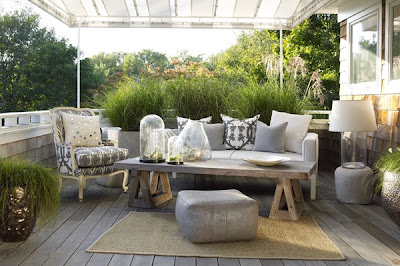
Outdoor Living
Increase you living space without a major remodel. In Northern California, you can live at least 6 months outside without threat of rain. Outdoor living can be as simple as a couple of lounge chairs. Our favorite is a dining area for beautiful dinner parties and al fresco lunches with friends and family.




Monday, February 13, 2012
Retrofit
transitive verb
1 :
to furnish (as a computer, airplane, or building) with new or modified
parts or equipment not available or considered necessary at the time of
manufacture
2 : to install (new or modified parts or equipment) in something previously manufactured or constructed
3 : to adapt to a new purpose or need
Many great organizations focus on greener building standards in new construction, but what about existing building. Retrofitting your home can save you money, provide a safer and more comfortable environment, and conserve natural resources. When deciding to go green, remember that it is often more sustainable to remodel an existing building than build a new one. A new building would require more materials to build and the home you left behind would likely continue to waste energy, water, and resources for the rest of its useful life.
Subscribe to:
Posts (Atom)